
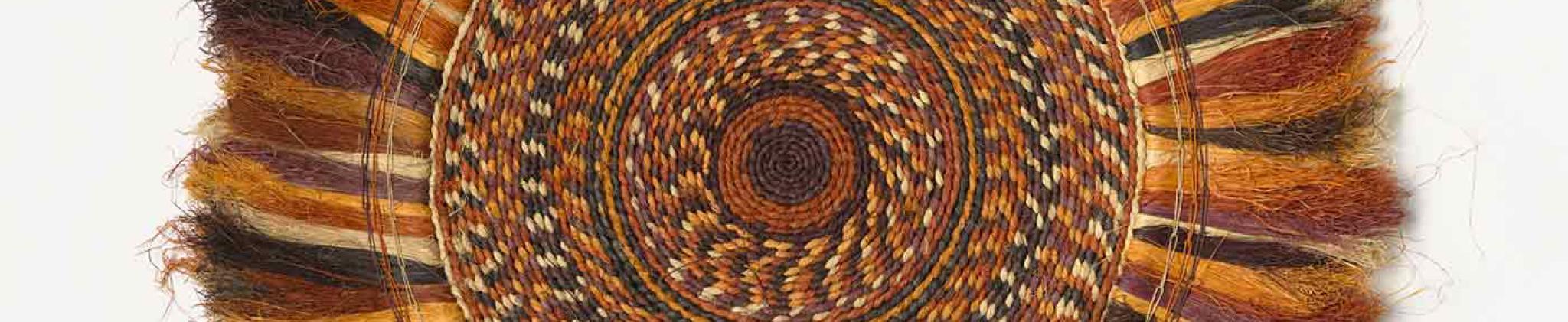
Wupun Sun mat by Indigenous artist Regina Pilawuk Wilson
Primary Landing Page
Oceania is the most linguistically and culturally diverse region of the globe, with over 1500 languages, or around 20% of the world’s linguistic diversity, shared among just 0.5% of its population.
What was the genesis of this extraordinary diversity, and what is the significance of diversity in today’s world?
The central aim of the Evolution of Cultural Diversity Initiative (ECDI) is to understand the drivers and processes underpinning cultural evolution and diversification in Oceania across the full span of human history, from first settlement some 60,000 years ago through to the present day. The partial accounts of these drivers and processes offered by individual disciplines – including archaeology, linguistics, history, anthropology, ecology, genetics, ontogeny and philosophy of science – will be integrated to generate a more subtle and powerful understanding of the region’s past and present.
To contact ECDI please email ecdi@anu.edu.au

Affiliate Members
Simon Coxe
Anton Killin
Rachael Brown
Ross Pain
Stephen Morey
Amina Mettouchi
Anna Florin
Mae Carroll
SYNAPSE is a trans-disciplinary seminar series hosted by the School of Culture, History & Language at the Australian National University. Seminars showcase the research of scholars committed to exploring questions about human history that emerge at the intersection of multiple disciplinary perspectives, including anthropology, archaeology, cultural evolution and ontogeny, genetics, history, linguistics, palaeoecology, and philosophy.
Presentation and participation in the Synapse series contribute to the development of a community of trans-disciplinary practice, building on networks that integrate ANU researchers with national and international colleagues. Synapse seminars are presented both in-person and online, and recordings are typically made available for those unable to participate in the initial event.
The SYNAPSE seminar series is part of the School of Culture History & Language Flagship program. Previously recorded seminars can be found on our YouTube channel.
The Evolution of Cultural Diversity Initiative (ECDI) brings together expertise in each
of the disciplines to tackle a number of key questions:
- What are the key drivers that account for cultural evolution from the deep past through to the present?
- What are the processes producing diversity (genetic, linguistic and cultural) and what influence do environmental contexts exert on these processes?
- How do innovations arise and diffuse in complex social networks?
- What new transdisciplinary methodologies and approaches should be developed to support these aims?
To explore these questions, ECDI will focus research attention and collaboration on four particular centres of diversity within Oceania – eastern Indonesia, northern Australia, New Guinea and Island Melanesia – as zones in which the ANU has had a long history of engagement.
Within these four zones, our research is further narrowed to address five cross-cutting research themes (Transdisciplinarity, Ontogeny, Culture and Socialisation, Consilience and Cartography, Narrative, Detecting Remote Historical Signal), as these have played out in five specific research areas defined in time and space (Peopling Sahul, Holocene Revolutions, Local Diversification, Transitions, Island Melanesia after Lapita).
Transdisciplinarity
Research theme lead: Lindell Bromham
Trans-disciplinarity is central to ECDI’s ethos: only by putting together the complementary information about cultural evolution that comes from different disciplines can we approach an integrated picture of how humans have developed diverse cultural traditions, whether in Oceania or elsewhere in the world.
Read more
Our strength as a research network comes not only from our combined expertise in many key aspects of cultural diversification – evolution, genetics, history, philosophy, archaeology, linguistics, psychology, anthropology – but also in our demonstrated capacity for working across disciplinary boundaries. Transdisciplinary research is challenging: not only do different disciplines have different goals and traditions, they also have different ways of framing, communicating and testing questions. Successful transdisciplinary work requires a long-term commitment to a research framework and community building that brings researchers with a range of disciplinary skills together and provides the opportunity to work toward common goals. But it also requires an analytical framework that allows disparate lines of evidence to be brought together. We will make use of new Bayesian frameworks that allow us to maximize our use of available information from different sources to inform a priori estimates, allowing for the variable levels of confidence we have in each historical information source. By combining different data sources, processes and narratives within the same analytical framework, we can make the most of the information and approaches that we bring individually to explore ideas about past events and processes. The integration of disciplines binds all of these activities, whether through informal collaboration or a formal analytical framework.
Ontogeny, Culture and Socialisation
Research theme lead: Evan Kidd
How people are socialised into cultures cultural ontogeny is a vital part of cultural reproduction and adaptation, since people only function as effective actors in their societies if they have been taught the values, language(s), cognitive outlooks and technological practices that characterise them, and have been socialised into the local social network.
Read more
Changes in socialisation are also the main point at which the effects of contact and innovation enter into the system. Yet comparative studies of cultural ontogeny lag way behind those that compare adult practices – research on child development has been historically skewed towards studies of WEIRD populations. In anthropology, few questions in the Ethnographic Atlas, the Binford Hunter-Gatherer Data Set, or in D-Place address ontogenetic issues.
This theme investigates the developmental processes that both enable and constrain individual cultural adaptation. Humans are a symbolic species, and while our capacity for symbolic representation is universal, children are enculturated into and acquire culturally-specific symbolic systems (e.g., language, religious practices). We will study the developmental roots of symbolic cognition across our diverse region, using a mixed-methods approach that aims to achieve both depth and breadth of coverage.
To this end, we propose several sub-projects. The first sub-project will focus on the development of language, the dominant symbolic system used by humans. Here we will conduct in-depth studies of language acquisition and socialization in strategically selected cultural groups, in addition to broader but necessarily less detailed studies across a wider range of languages and cultures. The second sub-project will focus on children’s first unambiguous demonstration of symbolic capacity – symbolic play (i.e., pretence, such as pretending a rock is an apple). Like language, symbolic play appears to be universal, and there are suggestions that the practice has played a significant role in cultural and linguistic evolution. We will conduct the most comprehensive cross-cultural study of the emergence of symbolic play to date. Finally, we will investigate another complex trait – relational cognition – how children come to understand complex mappings between symbols that are both universal (e.g., the relationship of duck to duckling is the same as tiger to cub) and culturally specific (e.g., human kin relations). A crucial feature of this strand will be leveraging recent advances in artificial intelligence (AI) methods to quantify children’s everyday experience. We will a) continuously sample children’s day-to-day experience, b) filter and process the raw data and organize it into meaningful psychological units, such as interaction quantity and quality, and c) model change in cognitive processing in relation to these units.
Consilience and Cartography
Research theme lead: Chris Ballard
Integrative theories and narratives require protocols for the aggregation of data of widely varying forms, supplied by multiple disciplines operating across a range of temporal and spatial scales (the recent D-Place initiative is a good example).
Read more
A major impediment to integration is that these theories and narratives are often expressed in vocabularies idiosyncratic to particular disciplines. Ethnographies, for example, are not typically written in ways that optimise their data for comparative purposes. Cartography is employed here as a rubric for the range of methodologies that need to be identified and further developed in order to integrate the findings of our core disciplines, and then represent them within unified frameworks or platforms. These platforms might take the form of large comparative databases that strive for parallel coverage across a wide range of domains, or of novel forms of mapping or visualization (e.g. language maps of New Guinea are not currently paralleled by the mapping of cultural traits, such as kinship types, political organisation, or agricultural methods). ANU is fortunate to have a world-class cartography unit, which will work closely with us to develop innovative approaches to integrating and representing data across space and time.
Narrative
Research theme lead: Kim Sterelny
The Research Areas below are mostly historical the aim is both to provide a causal explanation (not a mere chronicle) for each particular epochal event and to do so in ways that help us understand the general phenomenon that the event exemplifies.
Read more
For example, the aim is to understand the colonisation of Sahul in ways that both help us see what is unique about this event, but also its similarities with other human expansions into novel habitats. Such projects of historical reconstruction pose unique methodological challenges, partly because historical processes are data destroying and partly because these events are unique, rather than simple instances of general processes still in operation. No solution is perfect, but the best approximation is the construction of an integrated and detailed causal narrative. Detail and integration impose empirical constraints: detail, because there are many places in which narrative intersects with the surviving data; integration, because elements of the narrative are not free parameters, adjustable at will in order to fit the record as it is known. The construction of such integrated causal narratives is essentially interdisciplinary: the more independent evidence streams brought to bear, the stronger the empirical constraints on the narrative across space and time.
Detecting Remote Historical Signal
Research theme lead: Nick Evans
Recent years have seen highly successful attempts to adapt phylogenetic computational models to track language relatedness, date family trees of languages, and determine their geographical location at different nodes of the tree.
Read more
These methods have primarily used lexical data, on the assumption that changes in basic vocabulary occurring over time can reveal historical signal. A persistent worldwide problem in using linguistic data to build models of the deep human past has been the ‘time barrier’, with signals of relatedness between languages usually stated to fade beyond detection after around 10,000 years. This contrast with archaeology, where the 40kya barrier associated with radiocarbon dating was pushed back once new techniques like thermoluminescence dating and molecular genetics were developed. These made it possible to build phylogenies going back to the earliest humans and beyond.
An alternative approach is to infer phylogenies and contact from a wider range of language features. One of the most promising advances for detecting deep signal has been development over the last five years of the Glottobank Consortium under the triple auspices of Centre of Excellence for the Dynamics of Language at the Australian National University, the Department of Linguistic and Cultural Evolution at the Max Planck Institute for the Science of Human History in Jena, and the University of Auckland. Classic methods, which look for relatedness based on regular sound-relationships between the forms of words and their parts (e.g. English thou Sanskrit tvám, English we Sanskrit vayám, English us Sanskrit asmān, English you and Sanskrit yúyām, etc). But these similarities eventually get worn away by the effects of change – thou has effectively disappeared from modern English, and the Hindi words are nowhere as clearly related as the Sanskrit ones are.
Glottobank adopts a radically different approach, by compiling vast databases of linguistic structures likely to be found in all languages, and therefore not prone to loss in the same way. So far it has amassed data for over 1,000 of the world’s 7,000 languages, and the steady work building this over the last five years will soon move to the next phase, of developing methods for analysing this information to answer questions about the languages both of Oceania and of other parts of the world. One part of Glottobank, namely Parabank, contains information about paradigms – organised multidimensional patternings of words – and a key set of paradigms are kin terms. So the data here are useful not just for historical linguistic analysis but also for plotting kinship systems – with the implications these have for social structure – across the many hundreds of cultures for which we have descriptions; this will interface closely with methods §1 and §2 above. The next step in our analysis is to link in cognate sets across the 1,000+ individual languages represented in Parabank. to help us (i) develop a typology of pattern-change, (ii) to understand the effects of contact (both direct borrowing of forms, and borrowing of patterns) and (iii) harness this new approach to model deep-time patterns of historical connection and change. For example, initial work comparing the patterning of pronoun paradigms across the Torres Strait gives a very neat cleavage first at hemi-continental level and then by phylogenetic groupings on either side, but modulated by tantalising contact effects between the Western Torres Strait language and Kiwai.
Through analyses like this we plan to develop methods of detecting historical signal in compact but highly-organised parts of the semantic system, in ways that transcend the limitations of traditional methods and that generalise to the relations between ‘maximal clades’ – the largest groupings reconstructable by traditional methods – which is where the linguistic trail runs cold at present.
Peopling Sahul
Research area lead: Simon Haberle
Expansion, adaptation and diversification This is the founding period of human habitation in Sahul, itself resulting from the first significant sea crossing by modern humans, across the Arafura Sea.
Read more
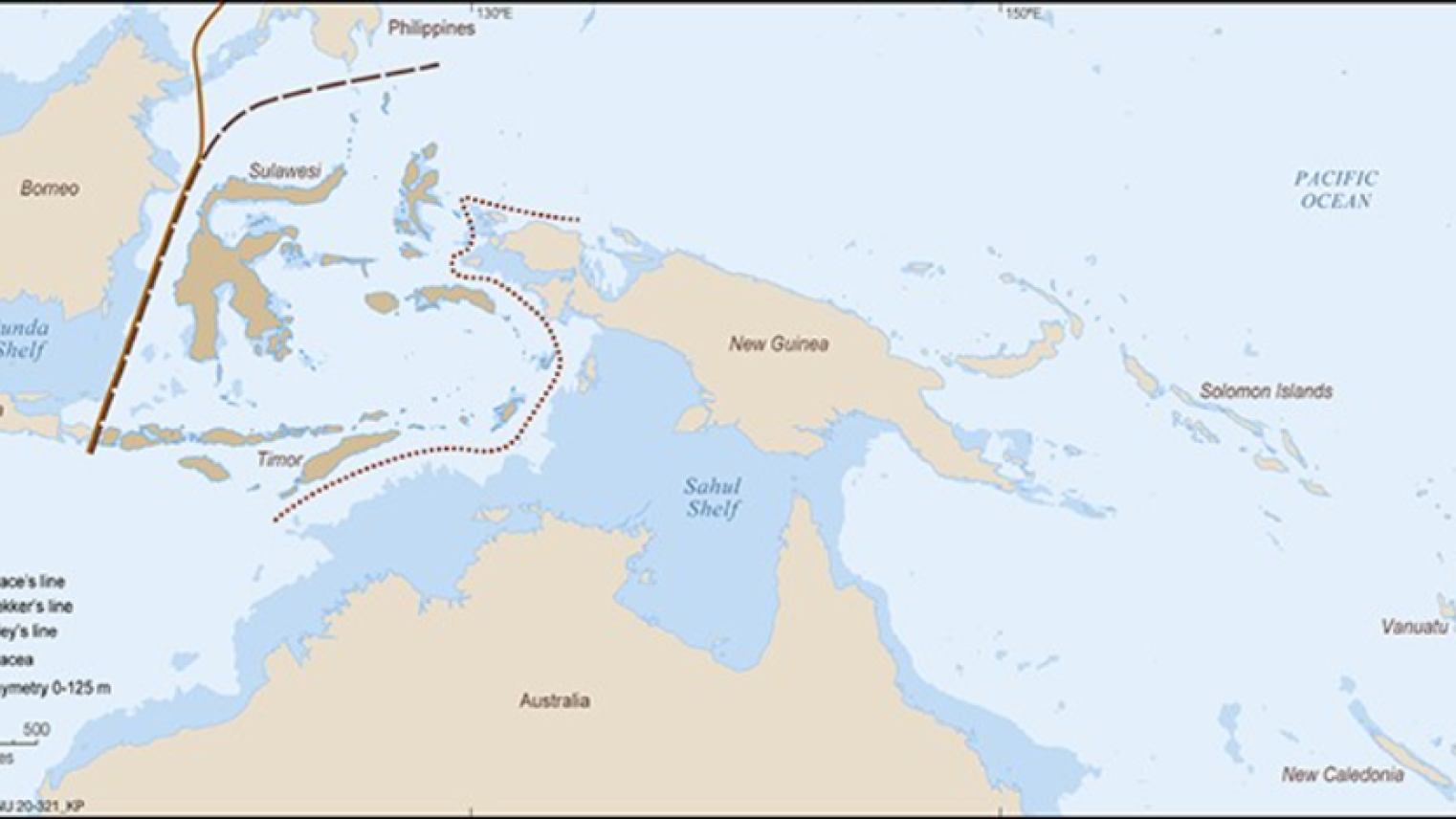
Who were the first humans in Sahul and how did their genomic composition reflect diverse processes of admixture on the Asian mainland? What were the points of entry and how many streams can we identify? How quickly did humans spread out across the landmasses that are now Australia and New Guinea, and by which routes and what dates were the various more challenging environments reached? What role did climate change and past environmental dynamics play in shaping the movement and adaptation strategies of people as they traversed major biogeographic barriers such as the Wallace Line and the arid centre of Australia? Was cultural adaptation to the radically new environments of the Sahul rapid, or was it scaffolded by a relatively long occupation of zones that were more commensurable with the recent pasts of these people? What is the deep history on the northern side of the Arafura Sea, which served as the springboard for peopling Sahul some 60,000 years ago, but which has also seen the westernmost and most recent migrations of Papuan speakers? Archaeological findings, though constantly expanding in range (and perhaps in time-depth), have not yet been integrated with data from the fields of linguistics (‘time-horizon problem’, see above), palaeoecology (climate-fire-human-ecosystem interactions through time), anthropology (modelling of small-scale group dynamics), and genetics (lack of data from non-Pama-Nyungan languages). Can we bring evidence from those fields into the picture, to give us a fuller picture of this primal phase of human presence in our region? What were the human responses to these environmental changes? Did the distribution of linguistic and cultural diversity before this division anticipate the very different linguistic and cultural pictures we find currently on the Australian and New Guinea sides – in other words, were New Guinea and Australia already very different beforehand? Or do these pictures reflect different and more recent trajectories of cultural evolution, which have led what was originally a more homogeneous cultural fabric (or one with a more gradual differentiation from north to south) to evolve in quite different directions on opposing shores of this narrow sea? Do we find traces of ancient trans-Sahul connections in the linguistic, genetic or archaeological records? How closely tied are the environmental, linguistic and cultural trajectories of change during a period of dynamic and rapid transition from the late glacial to the Holocene?
Read more
One of the most striking aspects of this whole picture is the remarkable cultural separation of New Guinea cultures from their Australian relatives, given their relatively recent physical separation. When, why and how did Australia and New Guinea acquire their distinctive regional characteristics? Within this major cultural and geographic divide, there are two remarkable processes that distinguish the more recent cultural evolutionary history in Australia and New Guinea. In Australia, although there is archaeological evidence of human settlement across the whole hemi-continent 50-40,000 years before present, linguistic diversity suggests a more recent cultural sweep. Languages from a single family, the Pama-Nyungan languages, cover seven-eighths of the continent while around 25 other groups are crammed into the northwestern one eighth. The drivers of Pama-Nyungan expansions remain enigmatic and explanations fail to integrate well across disciplines: linguists have proposed mid-Holocene dates while the genetic data suggests populations within Pama-Nyungan look stable for much longer. How can these two different narratives be reconciled? Could the the radical environmental changes resulting in the flooding of Lake Carpentaria, and the submerged glacial landscape of the contemporary Arafura Sea and Torres Strait, have prompted not only a cultural expansion of Pama-Nyungan speaking peoples, but the total replacement of the earlier cultures that arose from the initial colonisation event (Topic 1)? In contrast to New Guinea, there is no agricultural revolution linked to the Pama-Nyungan expansion, though there is some, though controversial, suggestions of an intensification of resource use in the Holocene. Do technological or subsistence changes in the archaeological record align with the hypothesis of cultural expansion and replacement? Did the dingo arrive in Australia before, during or after the Pama-Nyungan expansion? Is there a signature of ecological change that might indicate a radically different way of exploiting the landscape associated with a cultural sweep?
Holocene Revolutions
Research area lead: Kim Sterelny
Domestication and Intensification in Australia and New Guinea In both hemi-continents of Sahul, New Guinea and Australia, there are striking discrepancies in the distribution of linguistic diversity and disparity.
Read more
These point to apparently explosive processes of cultural expansion in relatively recent times, beginning probably in the early to mid-Holocene, and extending through to the present. On both sides, the processes and causes remain enigmatic but they hold the key to understanding the most important changes in the mid-distant past. On the New Guinea side, the vast Trans New Guinea family – with around 400 languages, the fourth or fifth biggest language family on earth, reckoned by numbers of languages – commands over half of the languages, with the other 400 are splintered across more than seventy small families and isolates. Expansions of Trans New Guinea languages have often been linked to the development of root-based agricultural techniques some 7,000 years ago, but the evidence is at best circumstantial – there are minimal reconstructable words for agricultural terminology in New Guinea, in contrast to well-known agricultural expansions like Uto-Aztecan or Austro-Asiatic. Alternative explanations, invoking primarily social causalities, have yet to be properly explored, nor have contemporary studies examined the expansion of TNG languages as it unfolds. Can we combine archaeological, genetic and linguistic analyses to uncover the history of cultural diversification in New Guinea? Currently, each of these sources of evidence is fragmentary or poorly resolved, but additional research and new modes of analysis should bring light to these long-standing questions.
Local Diversification
Research area lead: Nick Evans
Group Definition, Fission and Maintenance in Australia and New Guinea Most of our other themes look at the results of human cultural evolution – distinct languages, archaeological sites, different assemblages of anthropological features.
Read more
But to really understand how evolution works we need to document change and diversification in progress, and this topic focusses on that issue for two areas where the relevant forces can still be observed thanks to the maintenance of cultural and linguistic dynamics in relatively traditional forms: Southern New Guinea, and Arnhem Land. The causal drivers of these dynamics are both complex and interactive. These include the uses of language differentiation to index and maintain social differences, such as between clans and larger aggregates, the role of multilingualism as a vector of both divergence and convergence, the uses of material culture (such as different styles of manufacturing stone tools, or different conventions in painting or music) to index social group membership. These drivers interact with different patterns of social organisation, kinship, group affiliation, language affiliation and population genetic profiles. Important too are the various forms of feedback between group and intergroup dynamics, and the development of linguistic and material-culture differentiation.
Island Melanesia after Lapita
Research area lead: Chris Ballard
Movement, Evolution and Adoption The present distribution of cultural, linguistic and genetic traits in Oceania is a palimpsest of multiple layers of movement, evolution and adoption.
Read more
Conventional disciplinary approaches operating individually often struggle to grasp this complexity. The post-Lapita period in Island Melanesia has often been characterised in terms of the fragmentation of wider networks and the development of locally or regionally specific traditions, but the picture now appears increasingly more convoluted. “Back” migrations of Polynesian-speakers and the establishment of new circuits of movement and exchange promoted a diversity of forms of social organisation that cannot be explained in simple evolutionary terms. The visibility of these processes varies with disciplinary perspective – so-called “Polynesian Outliers” present as a particular subset of populations defined largely in terms of their retention of Polynesian languages, and yet archaeologically and ethnographically, a much wider range of “Polynesian” traits can be identified across the region, both pre- and post-dating the establishment of the classic Polynesian Outliers. Working in close combination, archaeology, palaeoecology, genetics, linguistics, anthropology and oral history can deliver much more convincing accounts of process informed by historical contingency. Central Vanuatu will provide one area of focus for this topic, with substantial resources already committed to unravelling the sequence of multiple introductions and adoptions of genes, cultures and languages, greatly assisted in terms of chronological calibration by the 550-year old Kuwae eruption.