
A Story in 15 Volumes: The Lumbers Family and the Sketchbooks of Hokusai
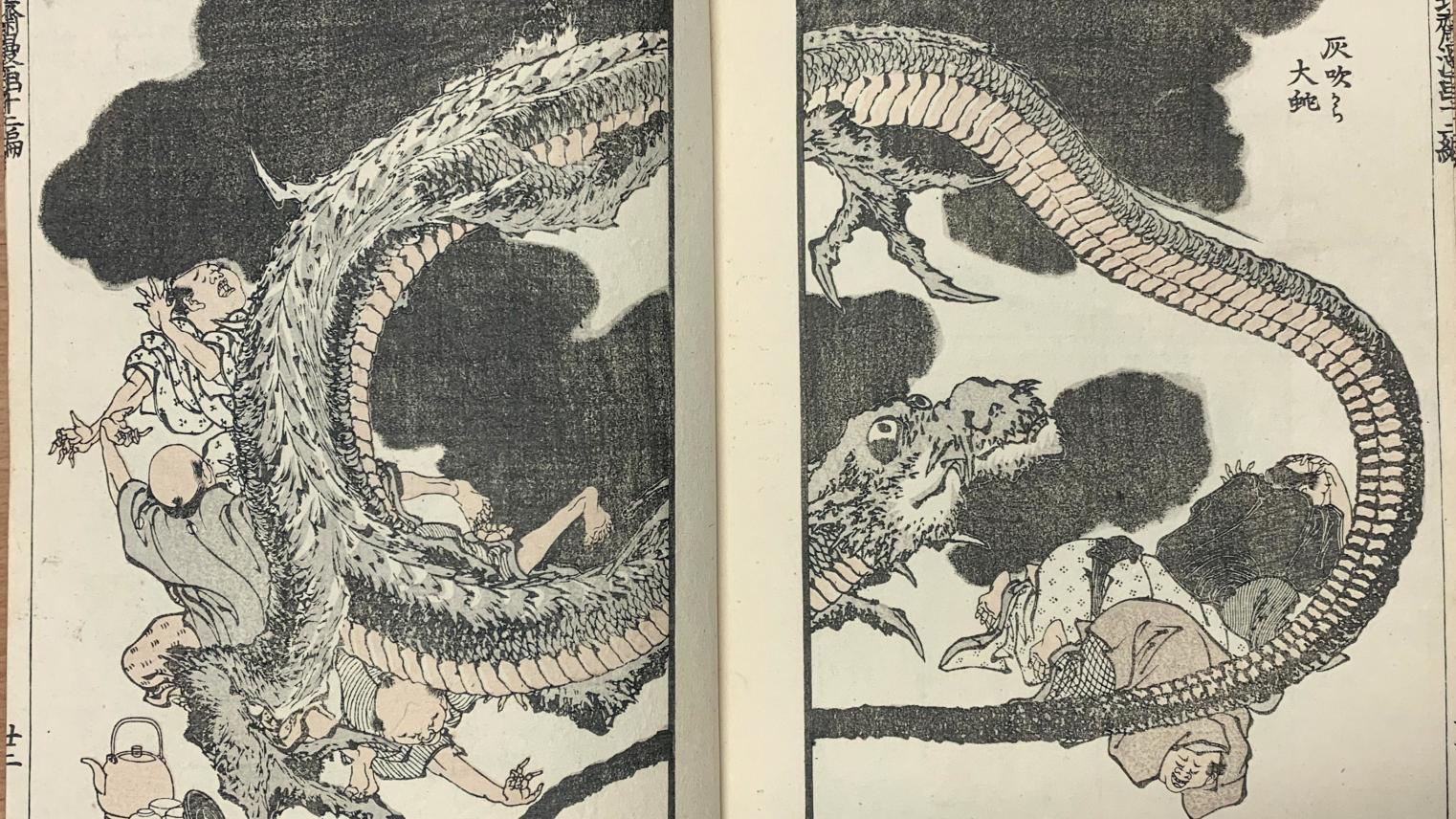
For decades, the small volumes lived quietly in a family home—in a wooden box tucked safely beneath a bed. They were brought out for curious eyes, leafed through with care, and then returned to their hiding place. To the children of the Lumbers family, the 15-volume ‘Hokusai Manga’ revealed more than book illustrations; they were fragments of another world, shaped by a history their family only partly understood.
Today, those same volumes have found a new home at the ANU College of Asia and the Pacific, where they form part of a wider story—one of art and memory.
A Post-War Journey
The ‘Hokusai Manga’, often called the Sketchbooks of Hokusai, first entered the Lumbers family through a friendship. After the Second World War, Richard Connard—born in Lancashire in 1882 and later an Investigator in Charge of the Investigation Branch of the Special Intelligence Bureau in Adelaide—served in the Allied Occupation of Japan between 1945 and 1952. During this time, he likely acquired several Japanese woodblock-printed books, including the ‘Hokusai Manga’. The family believes the ‘Hokusai Manga’ was gifted to him by a former Japanese Army officer whom Connard had assisted during the difficult post-war years.
To the young Lumbers’ siblings—Jim and Eugenie—Connard was an unforgettable presence. Eccentric, generous, and deeply invested in their education, he encouraged their achievements with enthusiasm. His home, filled with curiosities from a life lived between cultures, sparked their imagination and formed part of the backdrop of their post-war childhood. When Eugenie was studying medicine at University, Connard gifted her a porcelain teacup and saucer each time she did well in her exams. These have now been passed down to her granddaughters.
Sometime after his death in 1963, the Hokusai volumes passed into the hands of his close friend, Eugene Lumbers. Eugene, a writer of children’s books, radio plays, and television serials, brought them into the family home. An inscription dated 22 April 1968 marks the point at which the books were probably formally settled into the Lumbers household.
The children adored them. They sensed their value, though not their rarity; what struck them most was the boldness of Hokusai’s linework in the woodblock prints and the way the imagery seemed both ancient and alive. Eugenie remembers being particularly drawn to how Hokusai’s visual world resonated beyond Japan, influencing European artists of the late nineteenth century like Van Gogh, Monet and Degas, contributing to the Japonisme movement, which reshaped Western art. “Think of ‘The Great Wave’,” she reflects. “These images still resonate because of their uniqueness, their skill, and their visibility. They stand alone.”
From Home to a New House of Learning
When the time came to decide the fate of the books, Jim felt a clear pull toward ANU. The family’s connection to the University stretched across generations: Jim studied Political Science and French here; his daughter Juliette now works in Student Services; and his son pursued doctoral work in Entomology.
He felt that these volumes belonged in a place where Asia is central to research. Many editions of ‘Hokusai’s Manga’ were printed, however surviving sets of the edition published by Yoshikawa Hanshichi 吉川半七 in Tokyo are relatively uncommon. Hanshichi acquired the original collection of some 434 wood blocks with the license to print them granted in 1877 (Meiji 10). No public institution in Australia is known to hold a copy of the set published by Hanshichi.
“I didn’t want to go on keeping them under the bed,” Jim says simply. “They deserved to be somewhere they would be appreciated.”
Their arrival at ANU also provides new research potential. The ANU Library holds another nineteenth-century edition (Katano Tōshirō, Nagoya, 1875–78), meaning the Lumbers gift enables comparative study of variations in printing, wood block wear, and image recutting—offering scholars a tangible view into the history of the Japanese book trade industry in transition from the late Edo into the Meiji period.
Leafing through the volumes reveals dynamic sketches of a dazzling array of subjects, ranging from the light-hearted antics of everyday folk to sombre portrayals of deities to the pomp of courtly life, swordfights, wrestling, flora and fauna, terrifying mythical beasts, and serene landscape vistas—evidence of Hokusai's ability to document the broad range of Japanese culture and beliefs. Scholars today and in the future may glimpse the scope of the artist’s imagination through his innovative illustrations.
A Family’s Legacy
The donation is, at its heart, an act of generosity and trust in the University to preserve the work and make it available to future generations of readers and researchers to inspire new research and deepen understandings of Japan’s artistic legacy. It acknowledges the history of both Connard and the family—shaped by wartime memory, post-war friendships, and a lifelong fascination with culture and connection.
For Jim, Eugenie, and the wider Lumbers family, the gesture carries pride, relief, and hope. Pride in the object itself; relief that it now belongs to a community that recognises its worth; and hope that its journey, begun in post-war Japan and sheltered for decades in a family home, will continue to grow in meaning at ANU.
The ‘Sketchbooks of Hokusai’ have travelled far. Thanks to the Lumbers family, their story now continues—connecting past artistry with present curiosity'.


